
Knee injuries are very common in bully breed dogs such as Pit Bulls, American Bulldogs, Boxers and Mastiffs because of the confirmation of their legs.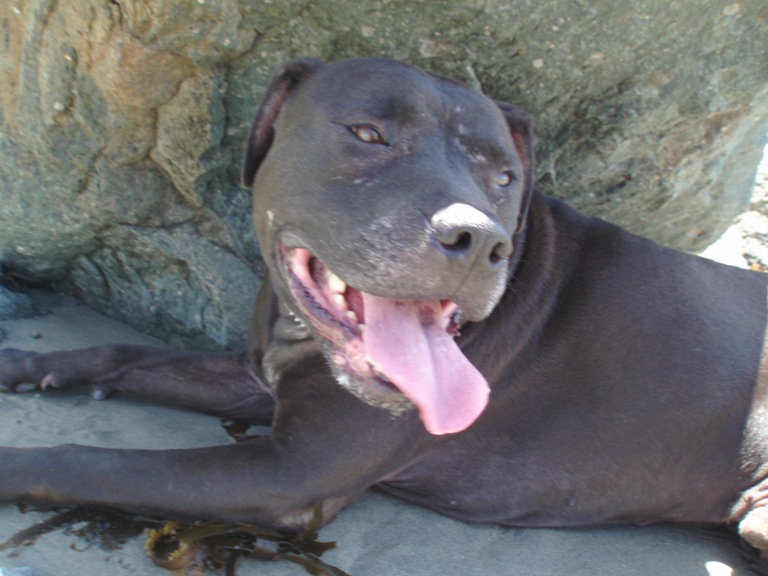 Also known as Cranial Cruciate Ligament (CCL) rupture, it most frequently happens in the rear legs of dogs and will initially present at lameness of the leg after exercise or immediately after injury. The lameness can be intermittent, but will return after long periods of walking/running or other activities. In addition to lameness, here are a few other symptoms to look out for if you suspect your dog has a stifle injury.
Canine Cruicate (Knee) Injury Symptoms:
- Decreased range of motion.
- Hind leg extended when sitting – this is known as the sit sign.
- Crepitus – crackling noise of bones rubbing against each other.
- Pain – when stifle (knee) joint is touched.
- Unwilling or resistant to exercise.
- Restricted mobility or extension.
- Stiffness after exercise.
- Swelling of joint.
- Thick, firm feel to knee are, may be hot to touch.
- Weight shifted to one side of body when standing.
- Exhibits toe-touching while standing.
When faced with this type of injury an owner has a couple of different options depending on the severity and onset of the symptoms. During your first visit to the vet they will want to take x-rays of the legs to rule out hip dysplasia or other issues. The x-ray will also give the doctor a good idea of whether or not there is ligament damage, but because soft tissues do not show up on xray it is not a certain diagnosis, and the dog’s symptoms need to also be taken into account if relying on x-ray imaging alone.
 The veterinarian will also perform a test on your dog called the clinical drawer sign. During the drawer sign test the doctor will physically manipulate the canine’s knee by holding the femur in place while attempting to move the tibia forward. Your dog may need to be put to sleep using anesthesia to properly do this test depending on the amount of pain your pet is in, and their willingness to have the test performed. Any forward movement of the tibia is known as a positive drawer sign and indicates that the dog has partial tears or a complete rupture of the cruciate ligament – the only way to tell for sure is with ultrasound or surgery.
There are a few other conditions with similar symptoms to cruciate ligament tears including:
- Acute arthritis – related to lyme disease or immune disorders
- Stifle (knee) joint sprain
- Meniscus (cartilage within the knee) injury
- Hip dysplasia
- Patellar (knee cap) fracture or luxation
- Myelopathies – diseases of the nervous system
If it can be confirmed that your dog has a cranial cruciate ligament rupture or tear you have a number of options both surgical and non-surgical. The most popular non-invasive and non-surgical method for ligament injury is known as conservative management. Treatment using conservative management, also known as CM, involves the use of anti-inflammatory medications, weight loss (less stress on the joint) and a one to two month period of rest.
There are a number of surgical options for healthy dogs and each owners should consult with their health care provider to find out which one is the best fit for their dog.
Surgical repair techniques for cranial cruciate ligament repairs:
- Traditional Repair or Extracapsular Imbrication Technique – A leader line is woven in a figure-eight pattern through the joint beginning at the outer aspect of the femur to the tibial crest. The heavy suture will eventually be replaced by scar tissue providing support for the joint.
- Tibial Plateau Leveling Osteotomy or TPLO – The head of the tibia is surgically altered and plated to create a new joint angle and prevent the femur from sliding off of the tibia. This procedure is an invasive on and involves cutting and plating of bone; it is associated with a higher rate of complications than the other surgical options.
- Tibial Tuberosity Advancement or TTA – This is very similar to TPLO, yet considered to be less invasive, and involves stabilization of the stifle joint by cutting the bone and changing the angles of the knee.
- Fibular Head Transposition – The head of the fibula is rotated and the lateral collateral ligament is moved in such a way that it mimics the cruciate ligament. The new positioning of the fibula is held in place using pins and wires. This procedure is not done very often and you may have a hard time finding a veterinarian that will actually perform it.
To read more about Dog ACL Knee Injuries and Canine Ligament Tears visit http://dogkneeinjury.com
I have a 3 year old male Labrador “Seal” with Canine Cruciate, that is the ligament had snapped in his right rear leg. I took him to the Specialist Veterinary Surgeon and was quoted $4,700 approx for a Tibial Osteotomy (TPLO) on his right leg. However when one of the legs has this problem, it is a recorded fact that the other leg will also “blow” within 6 to 12 months afterwards – requiring the same treatment and cost. The above Surgeon indicated that his left rear leg was painful at the tip and this would have caused him to put more weight on his right rear leg, which was what seems to be a regular occurrence with any sort of breed of dog, according to the Vet Surgeon.
I am on a Govt Pension & and I cannot afford the above cost. Such is life. I do not mean this to be a whine. I am giving “Seal” 1 x Rimadryl morning and night @ $4 each if I buy 10 and $2.50 when I buy a pack of 100+ on my Credit Card and Seal is showing no pain and very little discomfort – just a slight limp, now 4 months after the event.
However, I understand I can use Aspirin, which I can buy in the shops for $3.20 for 20 tablets AND it is essential to give the correct dosage by weight…see Dogs Aspirin on internet before deciding if this is for you. So I will give that a go soon.
I remain unconvinced that surgery is the only option. I think that without surgery the leg might freeze and if so, he might recover, although he is a big dog. Weighs in at 45kg today. The vet indicated that I might have to put him down eventually, but would give no time scale, so because $10,000 is out of the question, I will have to wait and see. Also I must try and get Seal to reduce weight. He hardly eats anything now and he has a slim dog diet, so I’m out of ideas there. Thus I will enjoy Seal for the wonderful and loving dog he is, as pain free as I can financially manage, until he recovers to not need pain killers, or until I am forced to have him put down, because I cannot bear to see him suffer.
Richard
If the ligament is torn it will take a very very long time to heal. The process is gonna be nerve wracking for you as well as your dog with insane restrictions. This is very hard to achieve even by professionals. Switch to a raw diet or slightly cooked meat and organs with chondriotin additives as well as certain fish oils. Dogs tend to recover much faster when on a raw diet. I’ve healed many dogs this way but I’ve never been able to heal a full rupture of the ligament. The cost you are mentioning is extremely high. You don’t have to do that type of surgery. Talk to a different surgeon and see how much would the Rope Technique cost. It should be significantly less than TPLO. In my professional opinion you would be best of performing this surgery so your dog can heal quickly and start running and being a happy dog. The slow restricted approach will go on for months and maybe even a year before you see improvement and it is nerve wrecking. Good luck.
Have you considered asking for funding online? People love to donate to pets in need. You could write his story & include some photos. Just a thought …
I would highly recommend finding a qualified Canine Rehab Therapist in your area. They should be able to give you a home program of exercises and hands on techniques to help your dog.
My boxer mix had TPLO on both legs. First leg was 2,500 dollars and 6 months later the other knee went- another 2,500 dollars. I think you should get another quote. that is high for just one leg. That was about 3 years ago and my dog is doing great! no problems. Fairly quick recovery without complication. If you can afford it– I would highly recommend TPLO. But, only from a doc who is well known and has done a lot of the procedures.
Help I have 2.5 year old beagle/rott mix? –Not really sure and in December he to his right CCL and had sugery ( extracapsular) to correct the problem. Last Thursday, he tore his left CCL. Because of his age and that he is a highly active dog, sugery is recommended. I have considered the option of CM as well. But if anyone is willing to share their experiences, I would gladly welcome them., as sugery is an highly desireable option but costly.
Thanks
I have a 2.5 year old staffy/bulldog mix who tore her CCL but did not wreck her kneecap or meniscus (cartilage within the kneecap) about 8 months ago.. We did not do surgery because of the cost and she has healed to the point where she can practically do everything she did before. She doesn’t chase the ball anymore and I don’t let her wrestle with other dogs that put their weight ontop of her, and no sprinting on hard flat surfaces but she is an all around off leash dog. She swims lots now to get her exercise, but it has taken some work to get to this point. She layed in the house for about 2 months with not even leash walks just quick pee&poop outside then back to laying down. This worked for my dog but they are all different, my girl is very inactive indoors and generally quite mellow. It is important to slowly reintroduce them to being walked as they can get reinjured incredibly easily. Thought I would just share this with you as a success story without the surgery but my dogs tear may not have been the worst case scenario, although the she was three legged (would just hold her back leg up not putting any weight on it) for months while it healed. I know everyone’s situation is different but I was told by my vet that it was worth a try to have her heal without surgery, as I could always decide to do it later on.
Thanks and good luck!! My heart goes out to your pup, I sure know it can be tough.
My 10 year old sheppard/bull terrier mix tore his right rear CCL about 3 months ago. We have tried CM with limited success. He does not seem to be bothered by his injury, except for holding his leg up frequently when walking. At his age, I’m considering not doing the surgery, though all 4 doctors we’ve seen recommend it. I just can’t see putting him through all the pain of surgery. Any comments?
There is a really helpful site dedicated to canine cruciate injuries and CCL repairs that you should check out – Dog Knee Injury
The creator of the site is the same person who did this site, and she writes a very detailed account of her dog’s experience with a CCL injury. Best of luck 🙂
My 3 1/2 year old lab/beagle mix was just diagnosed with a stretched anterior cruciate (they don’t believe it is torn). I think we are going ahead with the surgery, but I am curious if anyone else out there has had the surgery done (he is putting in a heavy thread). How is your dog doing today? Would you recommend it? Thanks in advance.
Don’t do the surgery if the ligament isn’t torn. Instead switch the dog from kibble to organic raw and keep him restricted from running/jumping. The rope technique for surgery works fine. It stabilizes the knee. Make sure you balance the raw diet. It is incrdedible how much faster dogs heal when on a raw diet. When you notice the dog walking with no limp for a few days increase exercise slowly still witjout running or jumping. Keep doing this ubtil full recovery.
Our 3.5 y.o. boxer/pit/? mix had the TPLO surgery in Sept 09. She made a truly amazing and surprisingly fast recovery and runs with me almost every day. However, the period of very limited activity was harrowing for us all. We had a board certified surgeon perform the procedure in Nthn NV and the staff were great – but this was very expensive and $1K more than the above ref’d – we shopped around for up to 8hrs travel! Today we very much suspect that the other back knee has a stretched CCL. Our dog seems to require activity for behavioural balance (our trainer told us someone else would have just killed her if they got her) and we’re concerned that if we don’t do the TPLO, or even one of the other surgeries, her quality of life will be pretty awful. We don’t earn a lot and work full time (at the moment!). We are also concerned about getting thru the trauma of the first 2 months after surgery – it was truly heart breaking and we wondered if we’d done the right thing.
Are there any others who’ve had the second back CCL stretch or tear? (BTW the stats our surgeon threw out were that if one tears there is a 50% chance of the other going within 6-18month of the first…)
Thanks for any help or advice – this will be a tough choice.
Hi Suzanne,
Tucker tore his other CCL about a year and a half after his Traditional Repair on the left knee. We opted this second time around to go the Conservative Management route – limited exercise, weight loss, anti inflamatories, etc. and successfully healed the knee without surgery.
How have things turned out for you??
We ended up doing TPLO for the other knee too and we couldn’t have asked for a better result (except for the pocket book, I guess). The second surgery was far less traumatic, healed much faster and she was released from returning to the surgeon only one month after surgery; it was also hundreds cheaper. She did break the head off one of the screws, but the surgeon wasn’t concerned and said that “determined” dogs (euphemism? 🙂 ) often rehab really well, because they want to use the leg right away. I suspect he was looking out for our pocket book too.
We have also realised that we probably had a dog in pain for about 2 years, as the crazy, happy dog we once knew returned. She can now run 10 miles w/o problem, plays with other dogs and runs most days.
There were a number of things that played into our decision: age, activity level and anxiety of our dog; the balance of arthritis and anti inflammatory drugs for a prolongued period of her life as well as possible long term costs; the vet tech I had on the day I had my local vet look at it, who had just done 4 failed alternative surgeries on her dog in an attempt to take a cheaper route; our surgeon’s opinion, experience and change in practice as to what he would prefer to do for bandy-legged, weighty bullies; the heartbreaking disability and pain she had before we did the surgery.
It has been very liberating for all of us!
There is a wealth of information available on Dog Knee Injury – http://dogkneeinjury.com regarding CCL tears, ccl surgery, and recovery from a cranial cruciate ligament injury in dogs. Hope this helps!
Hello Richard
Please talk to your doctor about Rimadryl and aspirin. This is a toxic combination and they should not be used together. It will kill your pet.Please do not mix the two
I just found out my Pit/Lab mix has a CCL rupture. We are treating with Adequan 100mg once a week and using the Rimadyl 2x a day. So far she is doing well. The x-ray wasn’t really that bad. So we are going with this first to see if it helps. She is using the leg some now. Before she walked on three and toe touched the right rear. I was glad I read this it was a big help.
have you had any problems since? looks like our dog has same issue and we really aren’t wanting to do surgery.
In the past year, my pup has torn both of her CCLs (about 6 months apart) and had surgery for both. I have been keeping a blog along the way, hoping others in this situation might benefit from reading our experience. If you’re interested, take a look: heidibsknees.blogspot.com
I hope you can, at the very least, find comfort in knowing others have gone through the same thing as you, and maybe you will even learn something that will help you when making decisions about your dog’s treatment! Best of luck to all of you and your pups 🙂
Question, how about icing the injured area to help with inflamation. surgery is so expensive – so mostly it is a matter of maintenance is . Humans ice injuries, but is that okay for your pup?
My 1.5 year old bullweiler is scheduled for a double fibular head transposition on each of her knees, she is 68 pounds. I am very concerned because there is much mixed information out there. Has anyone had this surgery for your dog? If so how successful was it over time? Please advise my heart is breaking for her and I don’t know what to do.
Roscoe is an 11-month-old American Bully. He’s been limping and tapping his toes and not putting weight on his back left leg (primarily) and right leg for the last couple weeks on and off. I took him to a vet to get checked out and the vet didn’t perform X-rays, but said he needs to rest and NO stairs for 3-4 weeks. She recommended Carprofen because his knee caps are popping out. She said it had something to do with the meniscus?
Without giving x rays her suggestions were:
Rest
Surgery or pain medication
It sounds like surgery is a boatload of money, so I’d like to try the carprofen/rest/raw diet for the next few weeks. Does anyone else have any suggestions? He eats Acana Beef Kibble and I’ve been reading through these replies and it sounds like I should switch him to an organic raw diet. And I’m not sure what Mg Carbrofren i should order him. He’s 54lbs but i want to lean him down maybe like 10 pounds?
Many thanks,
Sonia & Roscoe